Home › Steam whistle
Steam whistle
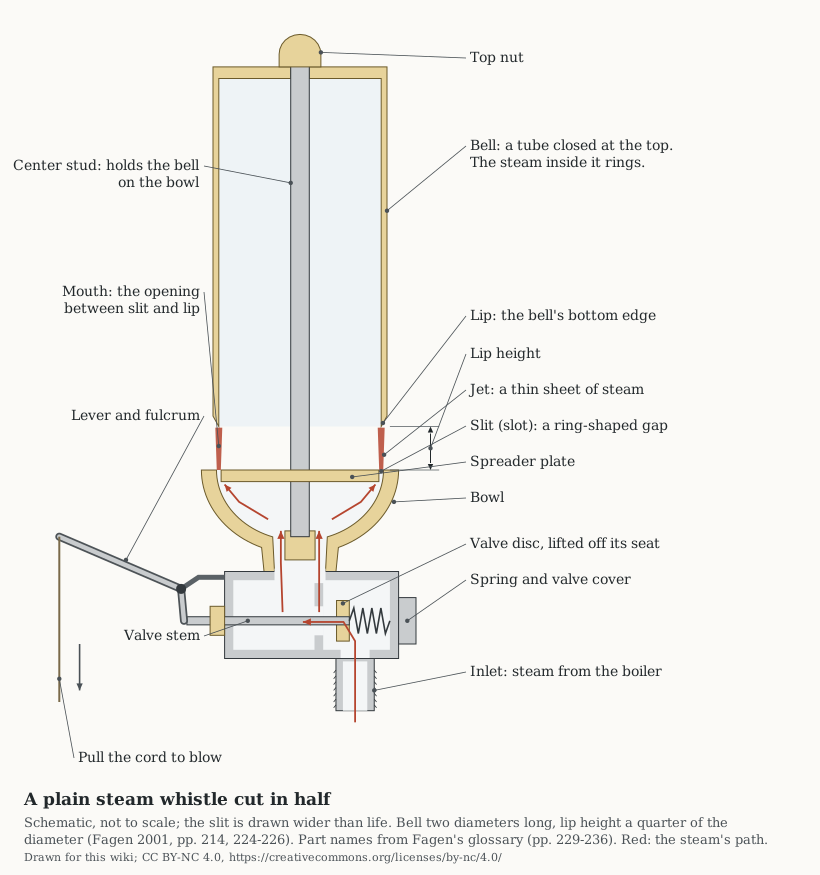
| Type | Aerodynamic whistle: a jet of steam sets the gas in a closed pipe ringing |
|---|---|
| Parts | Valve, bowl with an annular slit, bell (the resonator) |
| Invented | About 1833, by Adrian Stephens, as a boiler alarm |
| Kinds | Plain, chime (multiple-bell and single-bell), steptop, organ pipe, gong, variable-pitch |
A steam whistle is a signalling device that makes sound from a jet of steam, with no moving part. A valve lets steam into a bowl. The steam leaves through a narrow ring-shaped slit as a thin sheet and crosses the open mouth of a bell, a cup closed at its top. The gas in the bell rings at a pitch set mainly by the bell's length, and the sound comes out of the mouth.[1][2] Whistles were fitted to boilers, locomotives, ships, mills, factories and traction engines.[3][4]
History
| Year | Event |
|---|---|
| About 1833 | Adrian Stephens develops the steam whistle as a boiler alarm, to sound when the pressure runs too high or the water too low.[5] |
| 1833 | George Stephenson's "steam trumpet", a horn worked by steam, is made for the Leicester & Swannington Railway after one of its locomotives strikes a farm wagon at a crossing.[5] |
| 1835 | Thomas Turner of Sharp, Roberts & Co. shows a sketch of Stephens's whistle to the locomotive superintendent of the Liverpool & Manchester Railway, who adopts it. It displaces the trumpet on other English lines.[5] |
| 1836 | A whistle is fitted to the Susquehanna, an American locomotive built by the Locks and Canals Machine Shops of Lowell, Massachusetts.[6] |
| Before the Civil War | Whistles of several bells on a common manifold are used on ships.[7] |
| End of the Civil War | Near the end of the Civil War the bell is lengthened to lower the pitch, and the long-bell whistle comes into use.[6] |
| 1870 | The Pennsylvania Railroad has a standard long-bell whistle for its passenger engines.[8] |
| 1877 | John Einig of Jacksonville, Florida, is granted patent 186,718 for the single-bell chime. The Crosby Steam Gage & Valve Co. acquires the right to make it.[7] |
| Mid-1880s | Three-chime whistles are commonly heard on passenger locomotives.[7] |
| About 1905 | Five- and six-chamber cast whistles appear, whose open chamber tops rise like a spiral staircase. Steptops appear in Nathan's catalogue of 1907 and become the dominant American locomotive whistle.[9] |
| Second World War | Liberty and Victory class freighters carry a standardized plain whistle with an 8 in by 32 in bell.[10] |
On traction engines
Many traction engines carried whistles from the Buckeye Brass Works of Dayton, Ohio. Its plain bells were typically 2-1/2 times their diameter long.[11] Penberthy's long-bell plain whistles of 3 in or 3-1/2 in diameter were much favored for traction engines.[12] A traction engine of up to about 65 HP can feed whistles up to about 4 in in diameter. A 6 in whistle of conventional design draws 60 lb or more of steam a minute, and it quickly drops a traction boiler's pressure. Traction boilers are typically limited to 100 to 120 psig.[13]
The J. I. Case company issued a whistle code for traction engines in farm work:[14]
- one long blast: the engine had arrived at the working place;
- two short: it was about to begin work;
- one short: stop;
- two long: work was over for the day;
- three short: the grain haulers were to report to the engine;
- one long and three short: the water carriers were to report to the engine;
- a long series of short blasts: fire or distress.
How it works
The bell is closed at the top and open at the mouth, so it behaves as a stopped organ pipe. It rings at the frequency whose quarter-wavelength fits its effective length, so a longer bell sounds a lower note.[15] The ringing gas sways the jet across the mouth, and the swaying jet, blowing alternately into the bell and out of it, keeps the gas ringing.[2][16][17] The same whistle sounds higher on steam than on air.[15] How a steam whistle works has the full account.
Types
A whistle's nominal size is the outer diameter of its bell. The second specification is the length of the bell, measured from the lip on a plain whistle and from the spreader plate on a single-bell chime.[1]
A plain whistle sounds a single note.[18] Plain bells about twice as long as they are wide are short-bell whistles, and longer ones are long-bell whistles. A "3X" bell is three times as long as it is wide.[1][15]
A chime whistle sounds two or more notes at once. It takes one of three forms:[19][1]
- several plain whistles on a common manifold, a multiple-bell chime;
- a circular cluster of tubes on one bowl, the "Casey Jones" type;
- chambers of different lengths inside a single bell, a single-bell chime.
A single-bell chime with no top cap and stepped chamber ends is a Steptop whistle.[20]
An organ pipe whistle has a long, narrow bell, six or more diameters long, with one or more mouths that take up less than the full circumference.[18][15] A gong whistle has two opposed bells of the same diameter on a common axis, fed from one bowl with two slits. Abraham Fitts of Worcester, Massachusetts, patented it in 1865.[10][4] Variable-pitch whistles are also called mockingbird, fire alarm or combination whistles. A piston inside the bell changes its effective length while the whistle blows.[21][22]
Sound
A short, wide bell gives a pure, flute-like tone. A tall, narrow bell gives a piercing, nasal tone, strong in higher odd harmonics.[23][24]
Makers of three-chime whistles at first stressed consonance, with major and minor triads. Later chords included diminished and augmented triads. The five- and six-chamber steptops sounded sixth, seventh and ninth chords.[9][25] Examples include:
- the Hancock "steamboat" three-chime: A, C, E;
- the Pennsylvania Railroad shop-built three-chime: E, G, B;
- the Nathan six-chime steptop: D flat, E flat, F, A flat, B, E flat.
The Chime whistle page lists all ten.[25]
Making a whistle "talk" by working the valve is called quilling or twilling. The blower can throttle the steam, which pulls the pitch by up to a fourth and rarely a fifth.[26] Whistle blowers named many effects:[22]
- chirp: a tug that overblows the whistle.
- moan: a slow rise and fall in pitch.
- whoop: a rising slide, cut short.
- cry: a brief break in the sound.
- bark: soft chimes, then the valve thrown open.
- scream: a full pull, held.
- walk: short tugs in series.
- whippoorwill: imitates the bird.
Signals
The Association of American Railroads prescribed the railroad whistle signals:[14]
- Long and short blasts in set patterns told the crew to apply or release the brakes, to back up, and to send out or call back the flagman.
- Two short blasts acknowledged any signal not otherwise provided for.
- Two long, one short and one long warned of a grade crossing, bridge or tunnel. This was the "14L" or "Q" signal, and its last blast was held until the train was in the crossing.
Great Lakes vessels used a code of short and long blasts for passing, going astern, running in fog and danger. A long series of short blasts meant an emergency almost everywhere.[14]
See also
- Glossary of steam whistle terms
- Steam whistles
- Plain whistle
- Chime whistle
- Steptop whistle
- Multiple-bell chime whistle
- Long-bell whistle
- Quill, quilling
- How a steam whistle works
- Steam tractor
Notes
- ^ a b c dFagen 2001, pp. 21-22.
- ^ a bFagen 2001, p. 212.
- ^Fagen 2001, p. 23.
- ^ a bFagen 2001, p. 48.
- ^ a b cFagen 2001, p. 24.
- ^ a bFagen 2001, p. 25.
- ^ a b cFagen 2001, pp. 27-28.
- ^Fagen 2001, p. 26.
- ^ a bFagen 2001, p. 31.
- ^ a bFagen 2001, p. 232.
- ^Fagen 2001, p. 93.
- ^Fagen 2001, p. 127.
- ^Fagen 2001, p. 195.
- ^ a b cFagen 2001, p. 203.
- ^ a b c dFagen 2001, p. 214.
- ^Fagen 2001, p. 219.
- ^Fagen 2001, p. 220.
- ^ a bFagen 2001, p. 233.
- ^Fagen 2001, p. 230.
- ^Fagen 2001, p. 234.
- ^Fagen 2001, p. 235.
- ^ a bFagen 2001, p. 207.
- ^Fagen 2001, p. 215.
- ^Fagen 2001, p. 217.
- ^ a bFagen 2001, p. 33.
- ^Fagen 2001, p. 204.
References
- Fagen, Edward A. (2001). The Engine's Moan: American Steam Whistles. Mendham, N.J.: Astragal Press. ISBN 1-931626-01-4.