Home › Steam tractor
Steam tractor
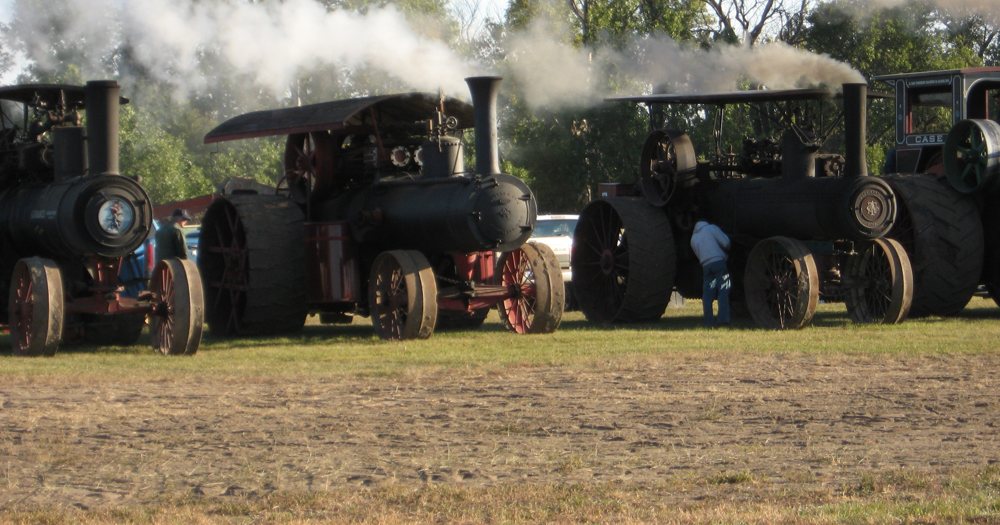
| Also called | Traction engine |
|---|---|
| Road speed | 4 to 6 miles an hour |
| Related | Portable engine, road roller, ploughing engine, showman's engine |
A steam tractor, also called a traction engine, is a steam engine on wheels that moves under its own power, as opposed to portable steam engines, which cannot move themselves and are moved by animals or by some mechanical device.[1][2] A fire boils water in its boiler, and the steam works an engine that turns the wheels.[1] Standing still, it drives other machines by a belt from its flywheel.[3][4] On American farms it threshed grain, pulled plows, drove belt machines and hauled loads, beside the horses and mules.[4][5][6]
Working parts
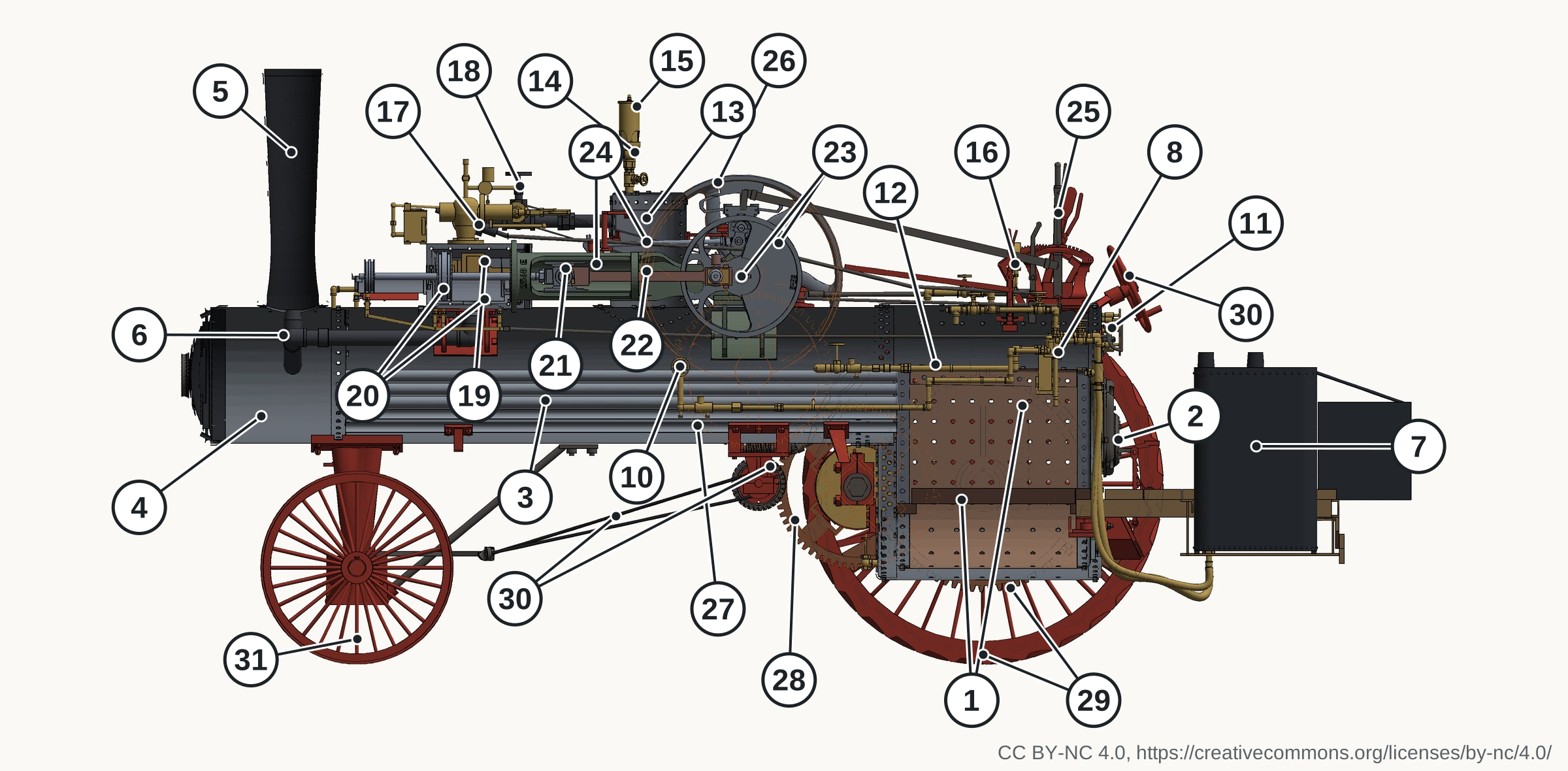
| No. | Part | What it does |
|---|---|---|
| 1 | Firebox and grate | Holds the fire. Water fills the space between the firebox's double walls.[7] |
| 2 | Fire door | Where the fireman puts in the fuel: coal, wood or straw, and on some engines crude oil.[8] |
| 3 | Boiler tubes | Carry the hot gases forward through the water. They are 2 to 4 inches across.[7] |
| 4 | Smokebox | Gathers the smoke at the front of the boiler.[9] |
| 5 | Smokestack | Takes the smoke away.[9] |
| 6 | Exhaust nozzle | Blows the used steam up the stack, which draws air through the fire. Before the engine runs, a blower pipe does the same with steam from the boiler.[10][11] |
| 7 | Water tank | Carries the water.[12] |
| 8 | Injector | Forces water into the boiler with a jet of the boiler's own steam.[13] |
| 9 | Feed pump | Pumps water into the boiler. It is worked by the crosshead, so it feeds only while the engine runs.[14][13] |
| 10 | Check valve | Lets water into the boiler and shuts if the water tries to come back.[14] |
| 11 | Water glass and try cocks | Show the water level. A try cock below the water level blows white mist; one above it blows blue steam.[15] |
| 12 | Fusible plug | A plug of soft metal in the top of the firebox, the crown sheet. If the water gets too low, it melts, and the steam puts out the fire.[16] |
| 13 | Steam dome | The highest point of the boiler. The engine takes its steam from the top of the dome, where it carries the least water.[9] |
| 14 | Safety valve | Lets steam out before the pressure gets too high. On traction engines it was usually set at 110 to 130 pounds per square inch.[17] |
| 15 | Whistle | Signals to the crew.[18] One short blast meant stop; two short blasts meant the engine was about to begin work.[19] |
| 16 | Steam gauge | Shows the pressure.[12] |
| 17 | Throttle | A valve in the steam pipe from the dome, usually opened and closed by a lever.[20] |
| 18 | Governor | Holds the engine's speed steady as the load changes. Two spinning balls fly outward as the engine speeds up and close a valve in the steam pipe.[21][22] |
| 19 | Steam chest and slide valve | The slide valve lets steam into one end of the cylinder while the used steam leaves the other end, then swaps.[20][23] |
| 20 | Cylinder and piston | The steam pushes the piston first one way, then the other.[24] |
| 21 | Crosshead and guides | The piston rod is fixed to the crosshead, which slides between the guides.[25] |
| 22 | Connecting rod | Joins the crosshead to the crank.[25] |
| 23 | Crank and crankshaft | Turn the piston's push into the turning of a shaft.[20] |
| 24 | Eccentric and reverse gear | The eccentric is a disc fixed off-centre on the crankshaft. Its rod moves the slide valve in time with the piston.[26] |
| 25 | Reverse lever | Sets which way the engine turns, and how long steam is let in on each stroke.[27][28] |
| 26 | Flywheel and friction clutch | The flywheel evens out the piston's push and carries the crank past the two dead points.[24] The clutch inside it connects the engine to the gears; released, it lets the engine drive a belt while the wheels stand still.[3][8] |
| 27 | Gearing | The engine generally runs at 200 to 225 revolutions a minute. Spur gears bring this down to the speed of the wheels.[29][3] |
| 28 | Differential | Lets the outside drive wheel turn faster than the inside one on a turn.[30] |
| 29 | Bull gear and drive wheel | A pinion drives the large bull gear on each rear wheel. The wheels' broad rims carry lugs to grip the ground.[30][31][32] |
| 30 | Steering | The hand wheel turns a roller through a worm gear. Chains from the roller swing the front axle. Large engines steered by engine power.[33][8] |
| 31 | Front wheel | Carries the front of the engine. The front axle pivots on a ball-and-socket joint.[8] |
On nearly all traction engines the engine was mounted on the boiler. The exceptions were undermounted engines, set beneath the boiler.[1] Frick built the engine on a frame on the wheels, separate from the boiler.[34]
Valve gear
Most traction engines had a reverse gear with one eccentric. The rest used the Stephenson link, which has two.[35]
| Gear | Eccentrics | Used by |
|---|---|---|
| Woolf reverse | One | Case, Huber, Buffalo Pitts, Port Huron, Minneapolis[36] |
| Stephenson link | Two | Nichols & Shepard,[37] Gaar-Scott,[38] Aultman Co., Colean[39] |
| Grime | One | Avery[40] |
| Marsh | Advance[41] | |
| Arnold shifting eccentric | One | Rumely[42] |
| Frick single eccentric | One | Frick[34] |
Use
Threshing
Steam traction engines drove most of the larger threshing machines. Horse powers and small gasoline engines drove the smaller ones.[43] An average steam outfit threshed 500 to 1,000 bushels of wheat a day, or twice as many bushels of oats.[43] The engine was set in line with the threshing machine and backed into the belt with the clutch.[44]
Plowing
Engines of 40 to 60 horsepower at the drawbar pulled 10 to 14 plows at once, where farms were large and labor scarce, as in the Northwest.[5] Steam plowing was used only on large farms and on level land.[45] A wagon of water and fuel had to follow the engine.[46] See engine gang plow.
Belt work
Standing still, the engine drove hay balers, corn shellers, water pumps, feed grinders, ensilage cutters and wood saws by belt.[4] See portable sawmill.
Hauling
Engines hauled grain to the station or market and fertilizer, and moved houses and barns. They pulled road graders, scrapers and road plows.[4][47] On the road a traction engine usually made 4 to 6 miles an hour.[2]
With horses and mules
In 1917 American farms still had about 25 million horses and mules.[6] In 1911 the horse sweep power was still widely used for threshing, because it cost less than a steam outfit.[48] A team hitched in front could often pull an engine out of a soft plowed field.[49]
History
| Year | Event |
|---|---|
| 1842 | Ransomes shows a farmer's road locomotive at the Royal Show at Bristol, driven by chain to one wheel.[50] |
| 1857 | The first self-moving ploughing engine, built by Ransomes for Messrs. Fowler, is shown at the Royal Show at Salisbury.[50] |
| 1858 | Thomas Aveling patents a chain drive that makes a portable engine move itself. Many portables are converted.[51] |
| 1861, 1865, 1878 | Britain passes the Road Locomotive Acts.[52] |
| 1870 | Aveling's engine at the Oxford show is driven wholly by gearing and steered from the footplate.[53] |
| 1878 | In America, portable engines are sometimes built to drive themselves.[54] |
| 1891 | Under those Acts, road engines are held to 4 miles an hour in the country, with a man at least 20 yards ahead.[52] |
| 1911 | Tractors driven by internal-combustion engines, on petrol, kerosene, distillate or alcohol, are coming into use in the United States.[55] |
Related engines
- Portable engine: the same boiler and engine on skids or wheels. It cannot move itself and is moved by animals or by some mechanical device. Gearing to the rear wheels and steering make it a traction engine.[1][2]
- Road roller: built like a traction engine, but as a rule with much heavier gearing and bearings, wider tyres, and one broad roll in place of the front wheels.[56] Some American engines could be made into rollers by fitting a roll and its frame in place of the front axle.[55]
- Ploughing engine: in Britain steam ploughing was generally done with two engines at opposite ends of the field, winding the plough between them on a wire rope.[57][58]
- Showman's engine: Ransomes' engine of 1896 for travelling shows carried a dynamo on a platform at the smoke-box end, driven by a belt from the flywheel. Its motion and flywheel were plated over "so as to lessen the risk of frightening horses".[59]
See also
- Steam engine
- Boiler
- Locomotive-type boiler
- Return-flue boiler
- Governor
- Injector
- Stephenson link motion
- Threshing machine
- Stationary steam engine
- Steam locomotive
- Woolf valve gear
- Stephenson valve gear
- Walschaerts valve gear
- Valve packing
- Snifter valve
- Steam engines
- Whistle makers
Notes
- ^ a b c dDavidson and Chase 1908, p. 436.
- ^ a b cEncyclopaedia Britannica 1911, "Traction", p. 119.
- ^ a b cPotter 1917, p. 177.
- ^ a b c dPotter 1917, p. 200.
- ^ a bPotter 1917, p. 201.
- ^ a bPotter 1917, p. 4.
- ^ a bStephenson 1910, p. 13.
- ^ a b c dPotter 1917, p. 169.
- ^ a b cStephenson 1910, p. 18.
- ^Stephenson 1910, p. 30.
- ^MacGregor 1911, p. 110.
- ^ a bPotter 1917, p. 168.
- ^ a bStephenson 1910, pp. 28-29.
- ^ a bStephenson 1910, pp. 25-26.
- ^Stephenson 1910, pp. 20-21.
- ^Stephenson 1910, pp. 48-49.
- ^Stephenson 1910, p. 23.
- ^MacGregor 1911, p. 107.
- ^Stephenson 1910, p. 219.
- ^ a b cStephenson 1910, p. 34.
- ^Stephenson 1910, pp. 40-41.
- ^Potter 1917, pp. 51-52.
- ^Stephenson 1910, pp. 34-35.
- ^ a bPotter 1917, p. 43.
- ^ a bStephenson 1910, p. 33.
- ^Stephenson 1910, p. 36.
- ^Potter 1917, p. 175.
- ^Potter 1917, p. 205.
- ^Davidson and Chase 1908, p. 449.
- ^ a bPotter 1917, pp. 177-179.
- ^MacGregor 1911, p. 121.
- ^Stephenson 1910, pp. 47-48.
- ^Potter 1917, p. 176.
- ^ a bStephenson 1910, p. 223.
- ^Potter 1917, pp. 171, 174.
- ^Stephenson 1910, pp. 221-240.
- ^Stephenson 1910, p. 228.
- ^Stephenson 1910, pp. 224-225.
- ^Maggard 1905, pp. 141, 151.
- ^Stephenson 1910, p. 232.
- ^Traction Engine Catechism 1906, p. 96.
- ^Stephenson 1910, p. 237.
- ^ a bDavidson and Chase 1908, p. 218.
- ^Davidson and Chase 1908, p. 456.
- ^Davidson and Chase 1908, p. 68.
- ^Potter 1917, pp. 181-182.
- ^Potter 1917, pp. 200-201.
- ^MacGregor 1911, p. 131.
- ^Davidson and Chase 1908, p. 455.
- ^ a bFletcher 1891, p. 193.
- ^Fletcher 1891, pp. 211-212.
- ^ a bFletcher 1891, p. 279.
- ^Fletcher 1891, p. 213.
- ^Thurston 1878, pp. 355-356.
- ^ a bThe Engineer, 31 March 1911, p. 333.
- ^Davidson and Chase 1908, p. 453.
- ^Encyclopaedia Britannica 1911, "Plough and Ploughing", p. 852.
- ^Thurston 1878, p. 359.
- ^The Engineer, 26 June 1896, p. 639.
References
- Davidson, J. Brownlee; Chase, Leon Wilson (1908). Farm Machinery and Farm Motors. New York: Orange Judd Company.
- Duncan, Louis (1911). "Traction". Encyclopaedia Britannica (11th ed.). Vol. 27. p. 119.
- Fletcher, William (1891). The History and Development of Steam Locomotion on Common Roads. London: E. & F. N. Spon.
- MacGregor, W. F. (1911). The Science of Successful Threshing. Racine, Wis.: J. I. Case Threshing Machine Co.
- Maggard, James H. (1905). The Traction Engine, Its Use and Abuse (3rd ed.). Philadelphia: David McKay.
- "Plough and Ploughing" (1911). Encyclopaedia Britannica (11th ed.). Vol. 21. p. 852.
- Potter, A. A. (1917). Farm Motors. New York: McGraw-Hill.
- Stephenson, James H. (1910). Farm Engines and How to Run Them: The Young Engineer's Guide. Chicago: Frederick J. Drake & Co.
- "The Royal Agricultural Society's Show at Leicester" (26 June 1896). The Engineer. London. pp. 638-639.
- Threshermen's Review Company (1906). The Traction Engine Catechism. St. Joseph, Mich.: Threshermen's Review Co.
- Thurston, Robert H. (1878). A History of the Growth of the Steam-Engine. New York: D. Appleton and Company.
- "Traction and Ploughing Engines in the United States, No. I" (31 March 1911). The Engineer. London. pp. 333-335.